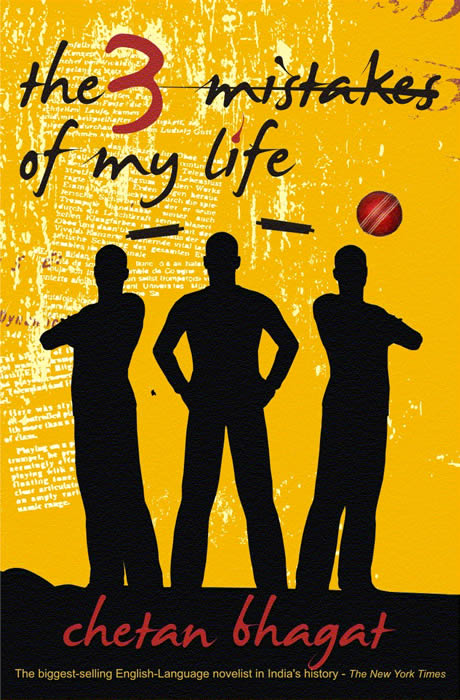
Three
Mistakes of My Life. This is the title of a book by Chetan Bhagat. I was on a
plane ride flying from one city to another in India (Delhi to Bangalore, I
think or other way around). A white guy in the aisle, looking for his seat,
while I sat in mine, mentioned to me in passing, “What are they?”, referring to
the title of the book in my hand. I smiled and said that I am still reading to
find out. He then said, “No, what are yours?”, while still standing in aisle of
the plane, as other passengers lagged behind at the entrance to the
plane.
I
was taken aback for a second. Mistakes? I never think of my life in terms of
mistakes, just lessons, I thought. I told him I don’t know, and asked him,
“what about you?” He lightly sighed with a hint of regret in his tone, said
“too many to count,” smiled, and walked to his seat, perhaps never to be seen
again.
He
left me with a question though: are there such things as mistakes in someone’s
life? And if so, how can/should they be perceived. At an early age, I had
molded myself to not focus on my mistakes, and direct my mind towards the
lessons to be learned from my journey or path. Hence, those mistakes are not
truly wrong turns in the course of my life, but the correct milestones
necessary for my path, no matter where that path is headed.
There
is somewhat of a circular logic and flaw in my argument, I realize. There is an
underlying assumption here that the path that I am on is never wrong – it is
never a mistake. The seeming mistakes are a part of the ultimate
correctness of things. Each “mistake” shapes my path, and that mistake is a
mistake in the whole sense only if the underlying path can be considered a
mistake.
We
now come to the question of, can my path be a mistake? On a religious or faith
level, I must believe that God or some type of Supreme Universal power is on my
side always, and hence my path cannot be wrong. Now let us take a more
pragmatic, agnostic approach. Assume that my path can be wrong, and the case of
interest then is one in which the path is wrong indeed. What is the course of
action then? Am I allowed to go back and change my path?
I
cannot change the past, and so I must change the course of my life from here
onwards if I care to. Either I am forever on the “wrong” path or I take it in
the direction which I consider “right”, as right as I can be assuming I have
been on the wrong path before. Now, my path becomes a mix of wrong and right.
As I do more right, it becomes more and more right and less and less wrong.
In either case religious or not, the situation boils down to, do I believe I am forever going to be wrong no matter what I do or do I believe I can change the path or change my actions (assuming the path is already correct). In the very recent past, when I felt like I had made some mistakes, I took refuge in the quote, “The only real failure in life is not to be true to the best one knows –Buddha (but it actually might not be from Buddha according to some guy http://www.fakebuddhaquotes.com/the-only-real-failure-in-life-is-not-to-be-true-to-the-best-one-knows/ ).
Recently, I also came across a ted talk by Kathryn Schulz, which made me rethink about the notion of regret, http://www.ted.com/talks/kathryn_schulz_don_t_regret_regret.html. She talks about embracing regret. She talked about how it is important to feel regret.
I
had always said that I do not want to have regrets in my life, when I am
speaking in prospect, and that is evident in my approach to life,
something I think about before my actions, but if I do have a regret
about something, it is the seed for a lesson with which to live my life after
certain actions. I realized I had stopped noticing and recognizing things
as “mistakes”. I had conveniently stopped viewing my actions as mistakes, so as
to avoid dwelling on regret and despair associated with the inability to
correct the past. Mistakes and regrets are nothing to aim for, but are a
welcome and necessary unintentional part of the life journey.
“When
the student is ready, the master appears,” said Buddha. I feel that regret is
the marker of our readiness, and a marker for the opportunity to learn and
grow.
The
guy on the plane was much older than me, perhaps in his forties or early
fifties. I wondered how mature he was to view his life as having many mistakes.
I wondered if it was our age gap that kept me from realizing I had mistakes but
have not lived enough life to see objectively the course of my life. I could
not answer his question because when I look back retrospectively, I do not see
mistakes, I see lessons. He might have meant mistakes that led him to realize
what to do in the future, but those are not true mistakes in my view. And in
the true sense, mistakes can only happen if one views the whole course of his
life objectively, determine what it was supposed to be, and compare it to what
it is instead. Since we cannot do that, and I believe that we do have the power
to change the course of life any time we want, we can have a mistake-free life
by treating our “mistakes” as mere lessons of the path – whether the path be
correct and intended from birth or whether we correct it as we go does not
matter. What matters is our belief that we are not forever doomed on the dark
wrong path. I did have an issue with Chetan Bhagat also using the terms
“mistakes,” and not “lessons” in a novel where the protagonist/narrator is
looking at his life in retrospect, even if the title proved to be a
conversation starter.
